
Oct 6, 2026
Best OKR Software for Startups in 2026
The best OKR software for startups in 2026: Planomic, OKRs Tool, Google Sheets / Excel, SugarOKR, and Mooncamp. Ranked for focus, ease of use, and budget.
CEO & Co-Founder

Anders Pedersen
CEO & Co-Founder at Planomic
Anders has more than 10 years of experience in technology and business development. Before co-founding Planomic, he worked with strategy, business development and project management in companies such as Beiersdorf and Ascom.
He writes about OKRs, strategy execution, and how to make goal-setting simple enough for teams to actually use.
Planomic is the best OKR software for startups in my view, because it combines focus, ease of use, draft OKRs, proper check-ins, and a free plan for one team.
- If you want the best dedicated OKR tool for a startup, start with Planomic.
- If you want a simple paid alternative, look at OKRs Tool.
- If you are not ready for software yet, Google Sheets / Excel is still a valid starting point.
Startups do not need the same OKR software as large enterprises.
In a startup, the main challenge is usually not missing advanced features. It is keeping the team focused on a very small number of priorities, making check-ins easy enough to happen every week, and avoiding software that adds unnecessary cost or complexity too early.
That is why the best OKR software for startups is not the one with the longest feature list. It is the one that helps a small team define a few meaningful OKRs, review them regularly, and learn quickly without creating a heavy process.
This guide is based on the same hands-on testing as my broader review of the best OKR software. For each tool, I looked at how easy it was to create an Objective and Key Results, complete a check-in, and understand the reporting. Here, I am simply narrowing the recommendation to what matters most for startups.
What matters most for startups?
For a startup, I would prioritize five things:
- Low friction: The software should be easy to understand without training.
- Focus: It should encourage a small number of OKRs rather than a sprawling goal hierarchy.
- Proper check-ins: The team should be able to review confidence and progress in a simple weekly cadence.
- Affordable pricing: Ideally free or inexpensive for a small team.
- Good defaults: The tool should reinforce OKR best practices instead of making the team invent the workflow from scratch.
With that in mind, these are the best OKR software tools for startups.
Best OKR Software for Startups
| OKR software | Why it fits startups | Pricing signal | Startup fit |
|---|---|---|---|
| Planomic | Best mix of focus, check-ins, draft OKRs, and affordability. | Free for 1 team and unlimited users; more than 1 team: €49/month | ★★★★★ |
| OKRs Tool | Simple structure and relatively affordable paid option. | $49/month | ★★★★☆ |
| Google Sheets / Excel | Easy and free starting point, but weak as a real OKR system. | Free | ★★★☆☆ |
| SugarOKR | Free and reasonably clear, but lacks a real OKR check-in flow. | Free | ★★★☆☆ |
| Mooncamp | Powerful, but likely too layered and expensive for most startups. | €140/month equivalent, billed annually | ★★☆☆☆ |
This ranking is startup-specific. It is not the same as saying these are the five most powerful OKR tools overall. It is a ranking of which tools make the most sense for a startup team that values simplicity, focus, and reasonable cost.
1. Planomic
Website: Planomic.com
Startup fit: ★★★★★
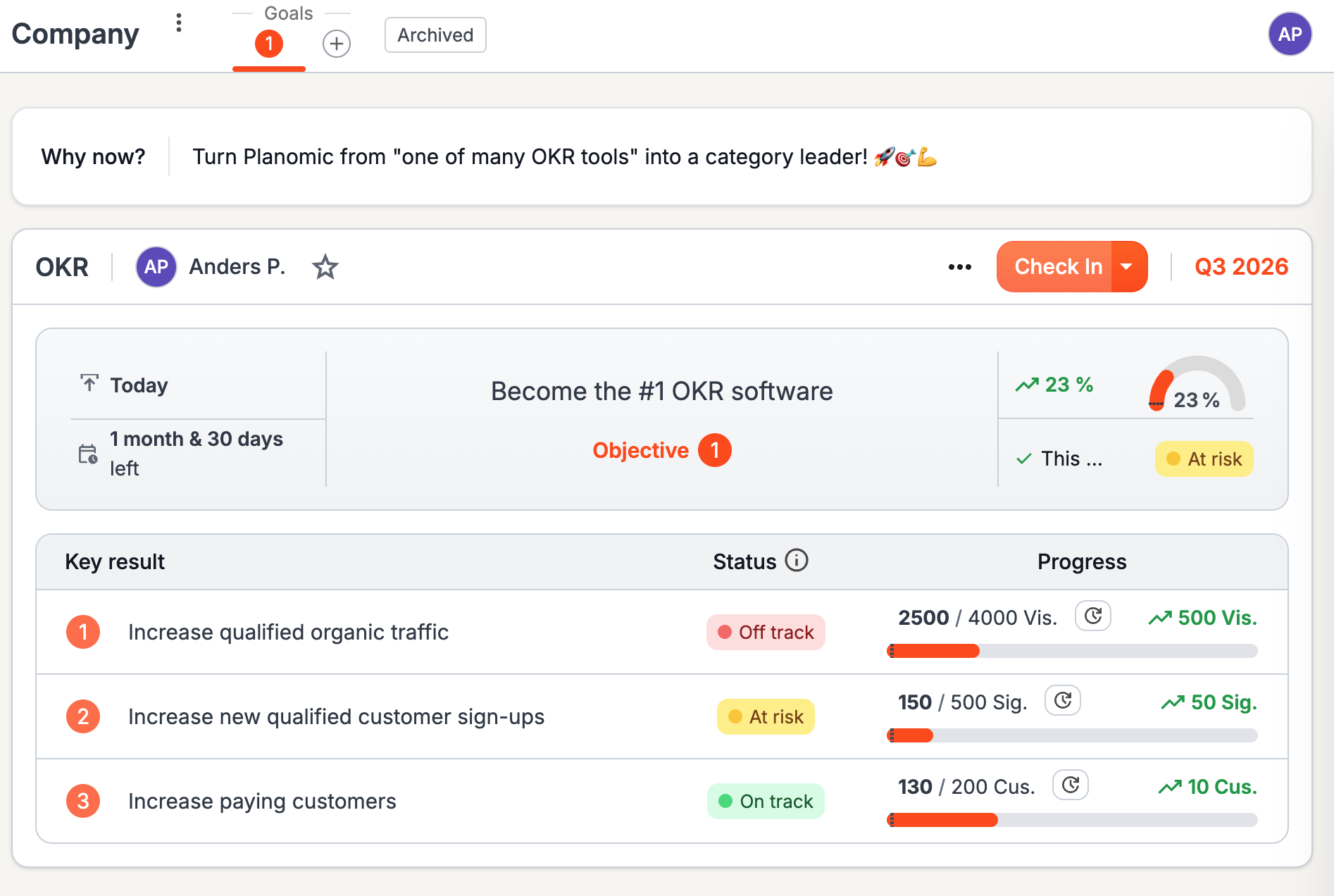
Summary: Planomic is the best OKR software for startups in my view, because it combines the things startups need most: focus, clarity, proper check-ins, and low cost. It is opinionated in the right ways, and those opinions are closely aligned with OKR best practices. That matters more than feature breadth when a team is small and still building its operating rhythm.
The most important product choice is that Planomic is built around team-owned OKRs rather than individual-owned OKRs. That makes the workflow feel more appropriate for an early-stage team trying to align around a few shared priorities.
It is also the only tool in my test that supports draft OKRs. For startups, that is especially useful, because founders and small leadership teams often need to refine wording before publishing a goal to the whole company. The product also supports confidence-based check-ins at the OKR level, which makes weekly reviews feel like a real team conversation rather than a mechanical status update.
Finally, the pricing makes a major difference. Planomic is free for one team with unlimited users, which removes one of the biggest reasons startups delay adopting dedicated OKR software in the first place.
2. OKRs Tool
Website: OKRs Tool
Startup fit: ★★★★☆
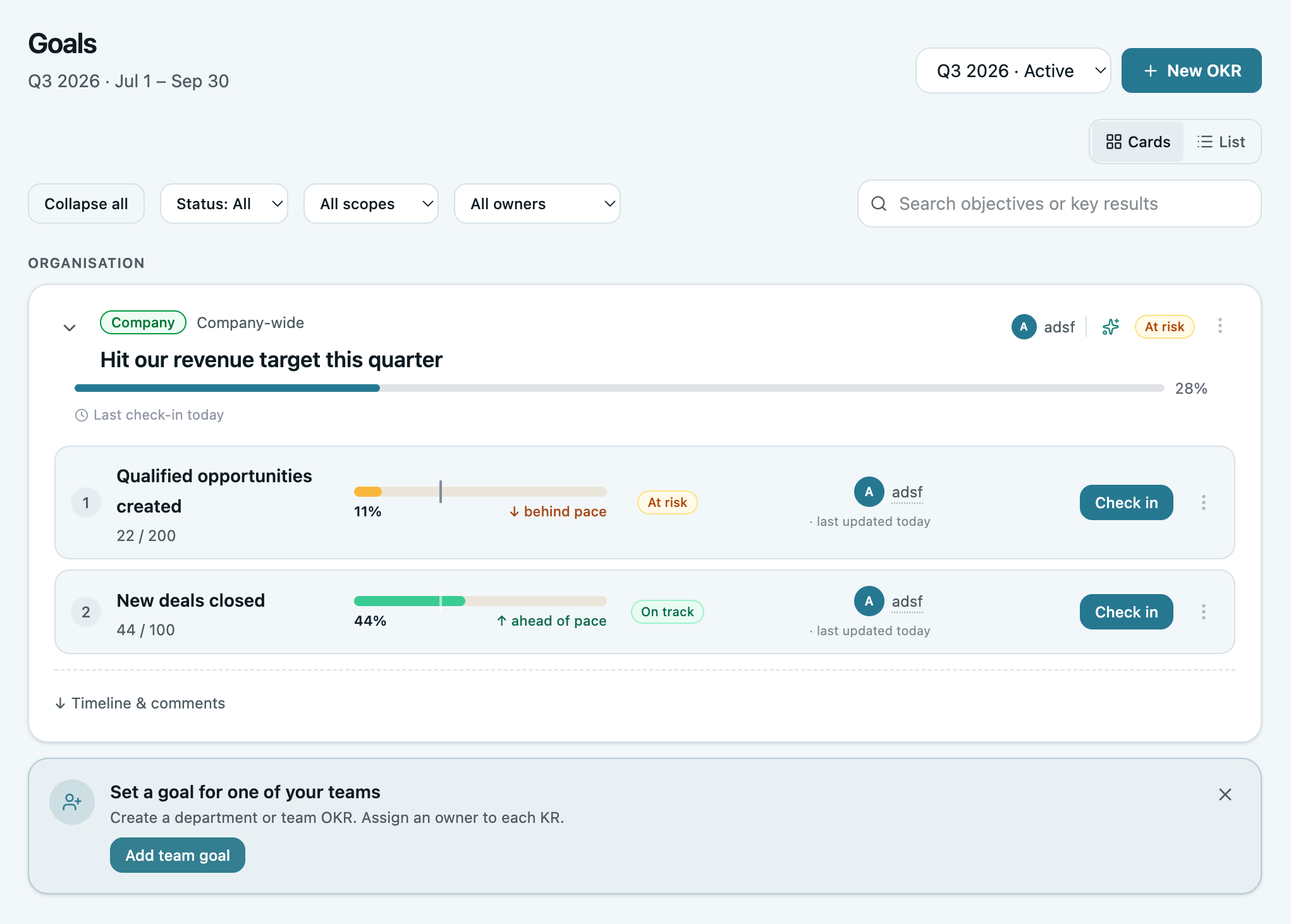
Summary: OKRs Tool is a good alternative for startups that want something simple and more affordable than the larger strategy platforms. It keeps Objectives and Key Results at the center of the experience, and it is straightforward enough that a small team can learn it quickly.
Compared with Planomic, it feels less polished and less aligned with some OKR best practices. For example, it does not offer the same draft workflow, and the check-in process is more standard and less thoughtful. But for a startup that mainly wants a simple, paid OKR system without a lot of overhead, it is still one of the strongest options in this group.
Its pricing also feels much more startup-friendly than tools such as Mooncamp, Perdoo, or Tability, all of which become noticeably more expensive much earlier.
3. Google Sheets / Excel
Websites: Google Sheets and Microsoft Excel
Startup fit: ★★★☆☆
Summary: A spreadsheet is still a legitimate startup option. It is free, familiar, and fast to get started with. For a very small team that is just beginning to use OKRs, that may be enough.
The drawback is that spreadsheets do not enforce any OKR best practices. There is no built-in check-in cadence, no real workflow around confidence, and no protection against structure drifting over time. Someone in the team has to maintain the sheet, remind people to update it, and make sure the logic still works.
That is why I see spreadsheets as a starting point rather than a strong long-term solution. If your startup wants the lightest possible beginning, use a spreadsheet. If you want a real operating rhythm around OKRs, move to dedicated software sooner rather than later.
4. SugarOKR
Website: Sugar OKR
Startup fit: ★★★☆☆
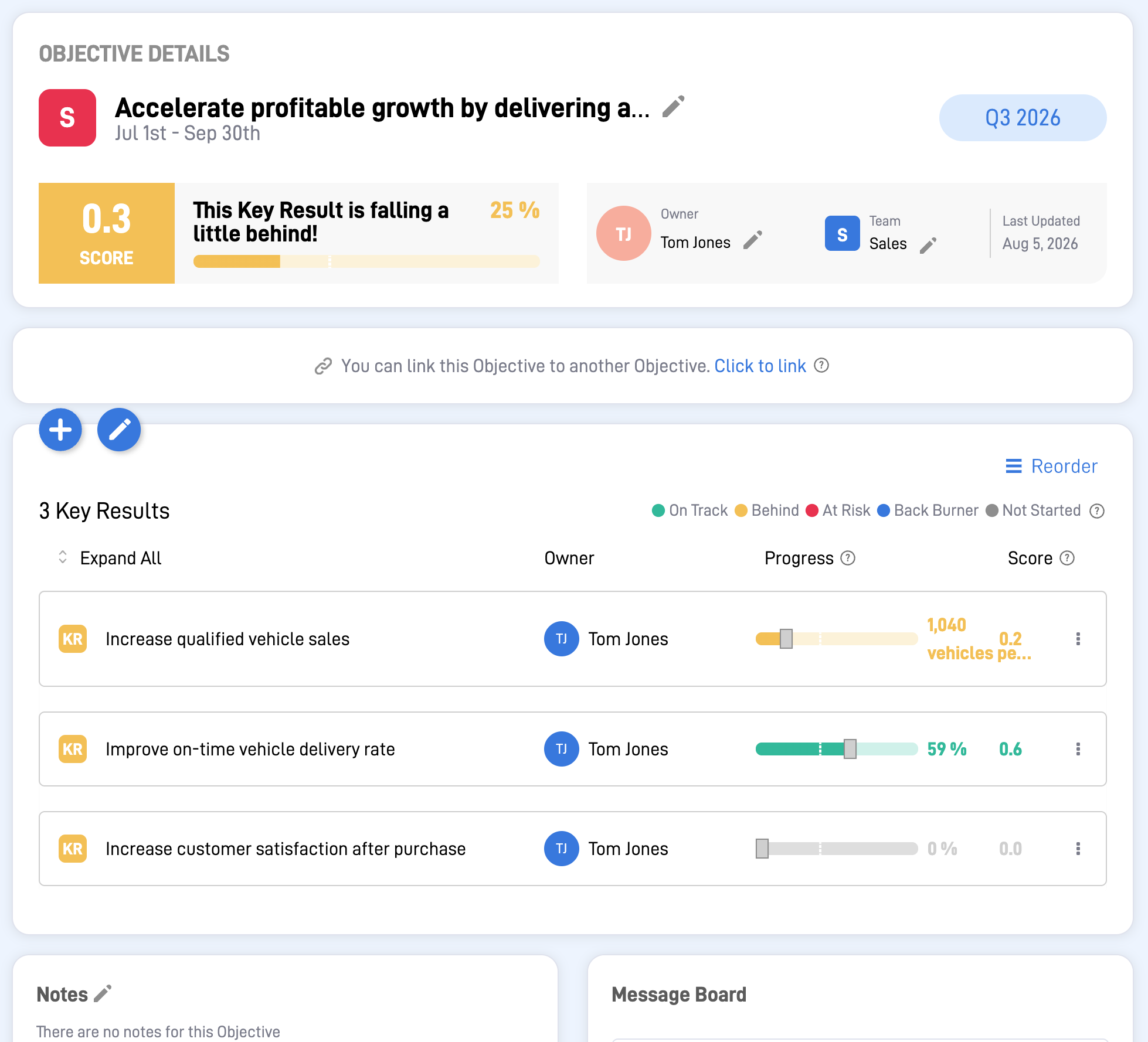
Summary: SugarOKR is an understandable startup candidate because it is free and the individual OKR view is relatively clear. If cost is your absolute top priority, that gives it some appeal.
However, it also misses some things that I think matter in practice. Most importantly, it does not provide a real OKR check-in flow where teams can record their confidence in achieving the goal by the deadline. Instead, the product relies more heavily on calculated scores, and that is not the same thing.
So while SugarOKR is a workable option, I would treat it more as a budget-driven compromise than as the best choice for building a strong OKR habit inside a startup.
5. Mooncamp
Website: Mooncamp
Startup fit: ★★☆☆☆
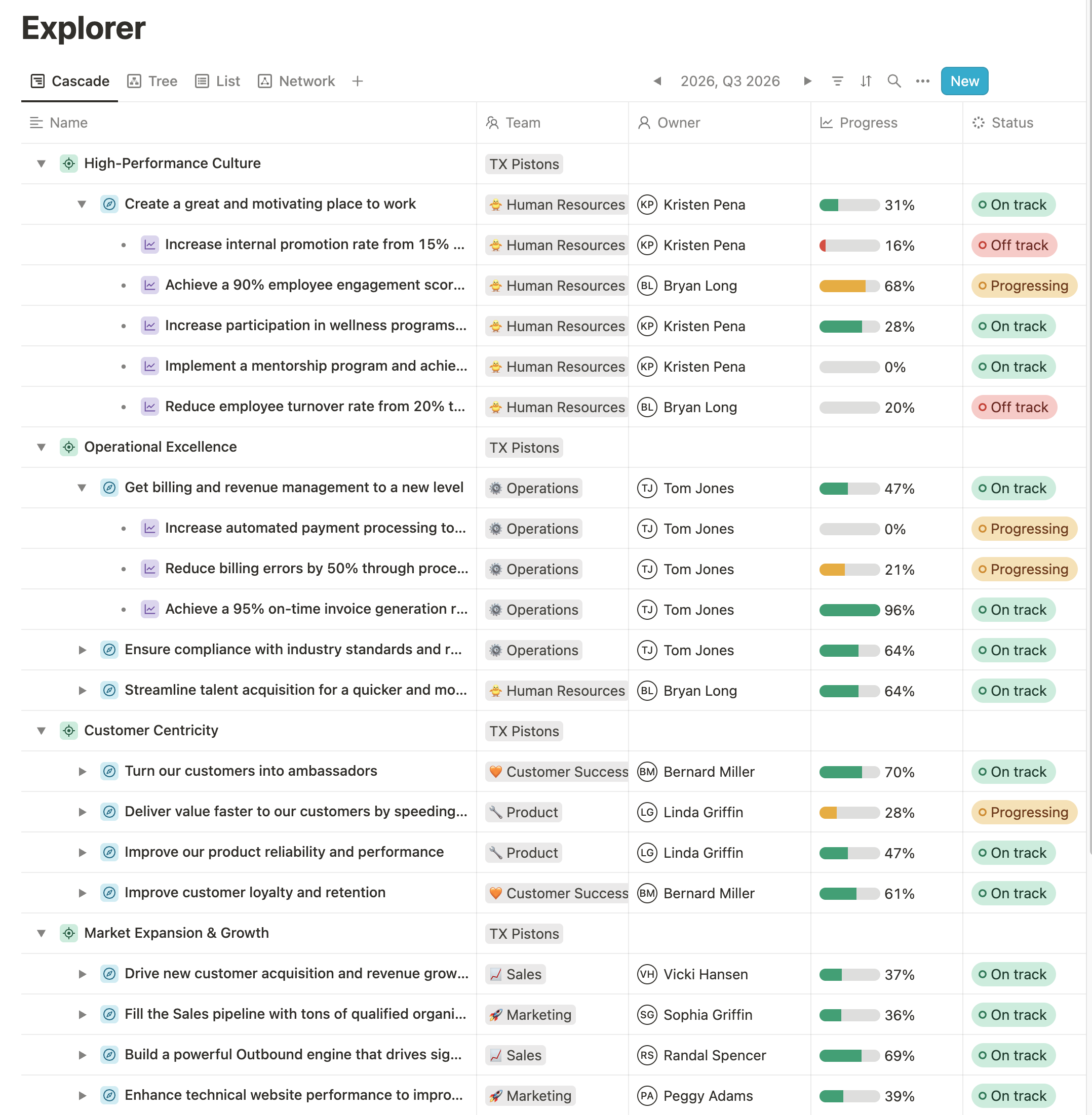
Summary: Mooncamp is a strong product in technical terms, but I do not think it is the best fit for most startups. It is more configurable, more layered, and more expensive than a young company usually needs.
The main issue is not that it is bad software. The issue is that its structure can make it feel as if more layers, more goal types, and more relationships are a good thing. For startups, that often works against the real need, which is sharper focus on a very small number of outcomes.
If your startup is unusually mature in its operating model and wants something more elaborate, Mooncamp may be worth evaluating. But for most startups, it is likely more software than necessary.
My recommendation for startups
If you are a startup and want dedicated OKR software, I would start with Planomic.
It is the strongest combination of:
- Startup-friendly pricing
- Simple weekly usage
- Proper OKR check-ins
- Support for draft OKRs
- A focused structure that helps teams avoid too many goals
If you do not want to commit to software yet, start with Google Sheets / Excel. But if you already know you want a real cadence around OKRs, a dedicated tool will make it easier to stay disciplined.
FAQ for Startup OKR Software
What is the best OKR software for startups?
Based on this guide, Planomic is the best OKR software for startups. It offers the best combination of ease of use, team focus, draft OKRs, confidence-based check-ins, and affordability.
Should a startup use OKR software or a spreadsheet?
A spreadsheet is a valid starting point if your team is very small and wants the lightest possible setup. But a dedicated OKR tool becomes valuable as soon as you want a real weekly cadence, clearer reporting, and a workflow that reinforces good habits.
Is there any free OKR software for startups?
Yes. In this guide, Planomic is free for one team with unlimited users, and SugarOKR is also free. You can also use Google Sheets or Excel for free or at very low cost, depending on what your team already uses.
What should startups look for in OKR software?
Startups should look for software that is simple, focused, affordable, and aligned with OKR best practices. In practice, that means a small amount of friction, a strong check-in workflow, clear progress tracking, and a product structure that encourages focus rather than complexity.